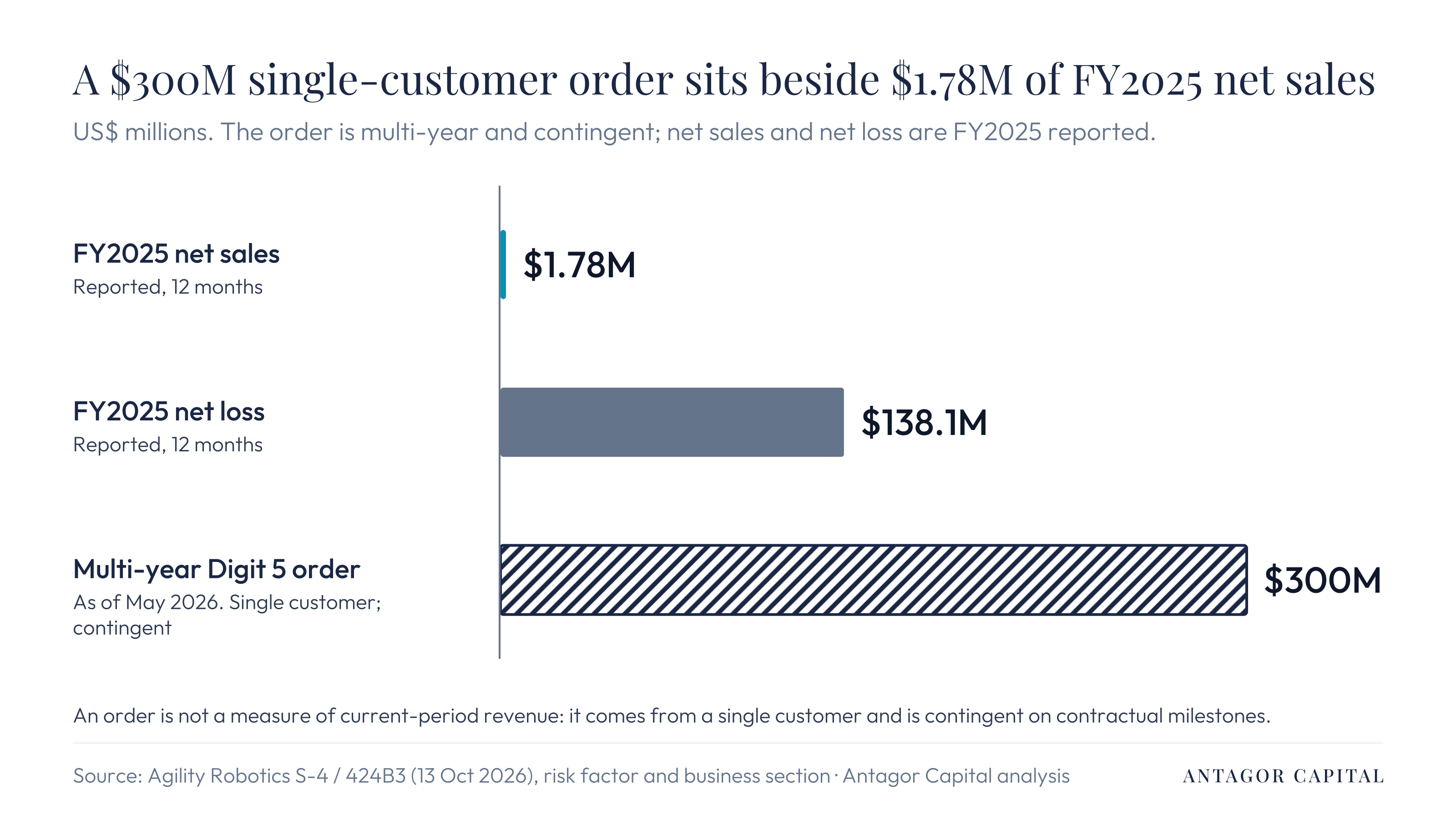
In 2025, Agility Robotics booked $1,781,967 of net sales and lost $138.1 million. In the same filing, it describes $300 million of Digit 5 orders from one customer. This is how to read the gap between those two numbers, as of 28 October 2026, while the business combination with Churchill Capital Corp XI (CCXI) is still pending.
Everything below comes from the final proxy statement/prospectus (Form 424B3, filed 13 October 2026) unless stated otherwise. It describes what the filing says. It does not tell you what to do with the vote on 2 November, which is your decision.
Key takeaways
- Sold versus ordered. Agility reported $1.78 million of net sales in 2025 and $174,000 in the first half of 2026. The $300 million is an order from a single customer for 1,000 Digit 5 robots on a three-year subscription, contingent on milestones and features. The filing says such figures are "not a measure of current period revenue".
- $8,500 a month is an assumption. It is the recurring fee in the S-4's illustrative unit economics, and the filing says actual contract terms are "subject to negotiation". It is not a published price.
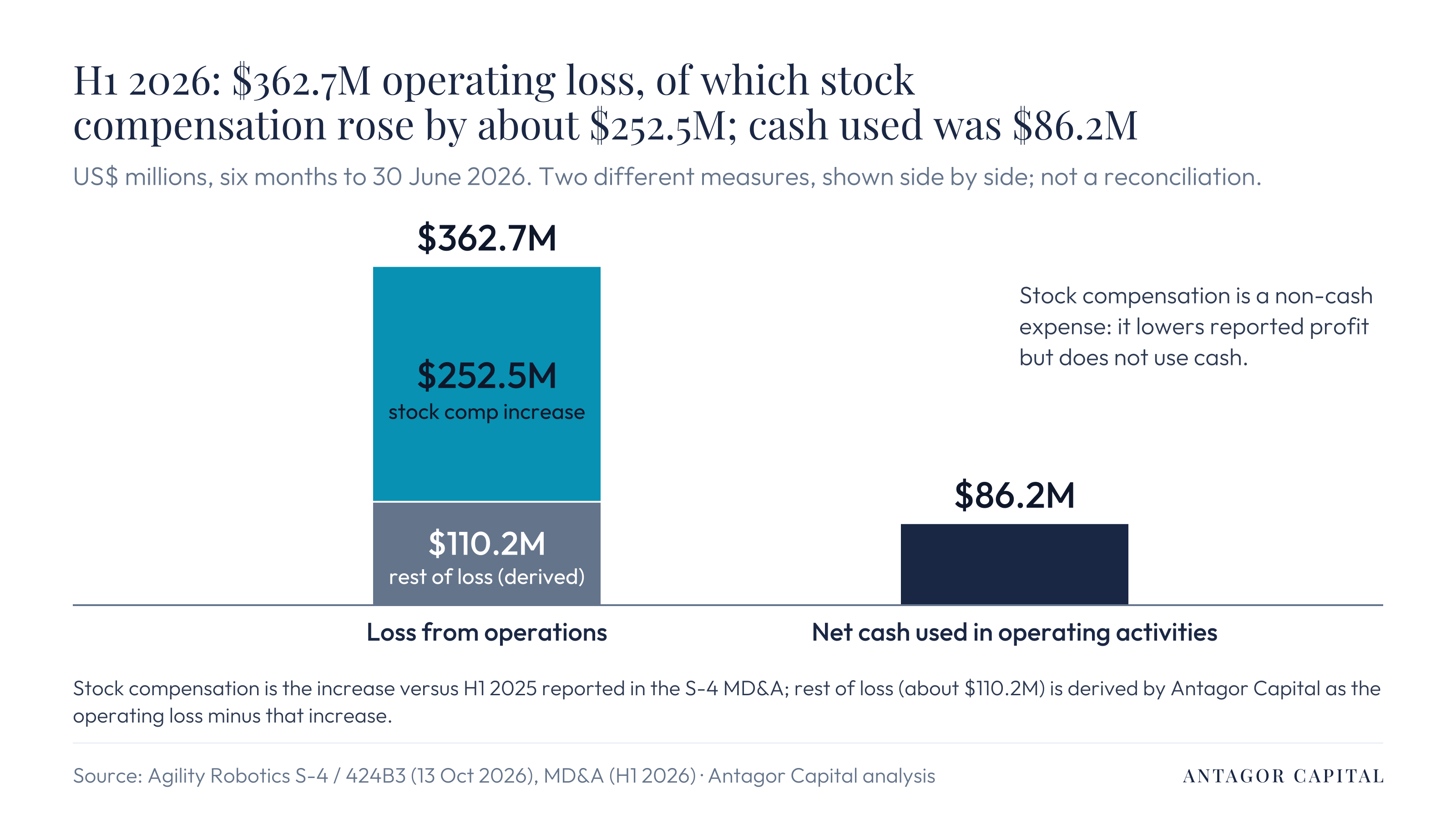
- The loss is bigger than the cash burn. Of the $361.9 million H1 2026 net loss, about $252.5 million was incremental stock-based compensation. Operating cash use was $86.2 million.
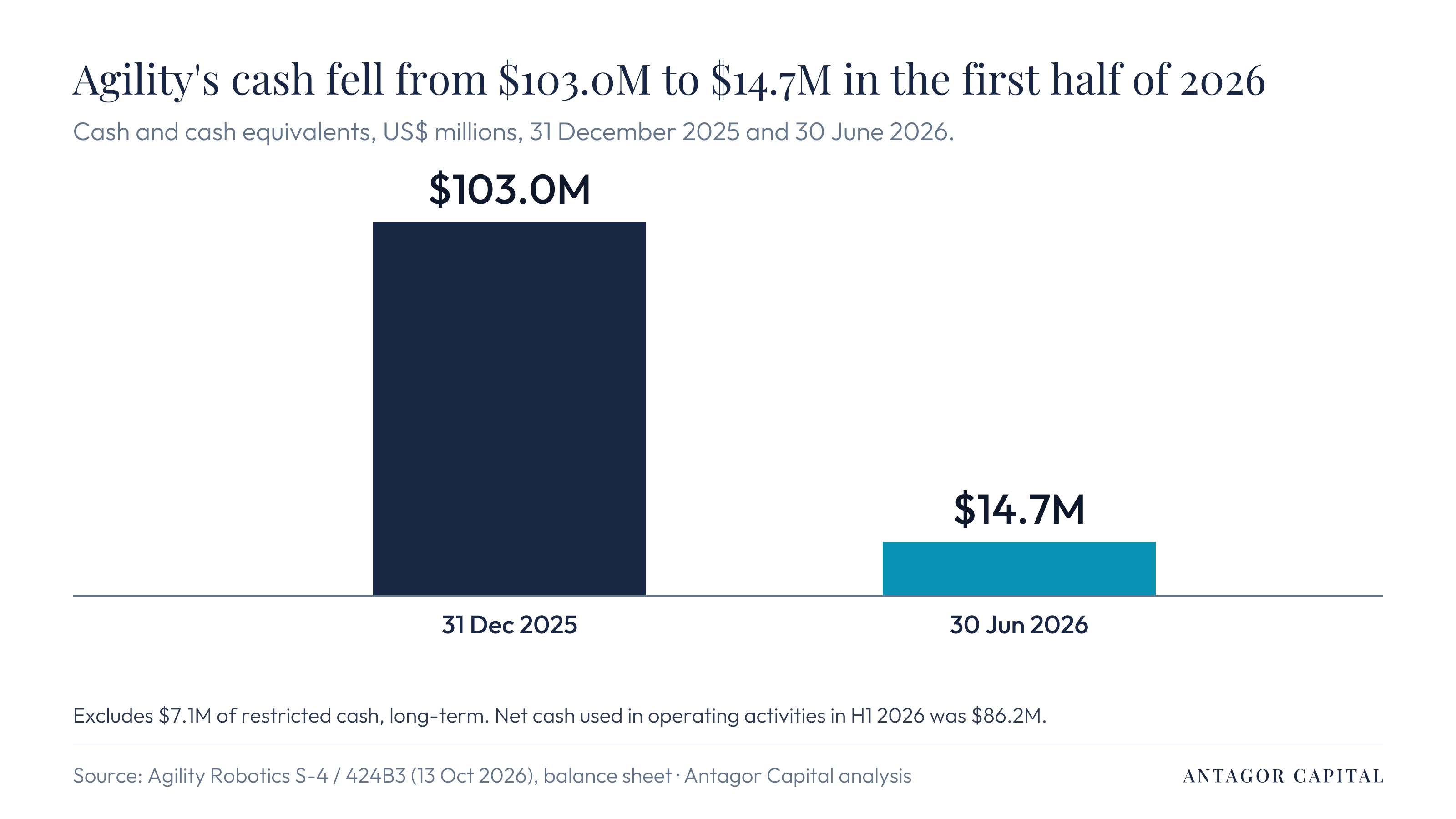
- Auditor and management both flag going-concern doubt. Cash fell from $103.0 million (December 2025) to $14.7 million (June 2026), and the doubt was stated without counting the proposed deal.
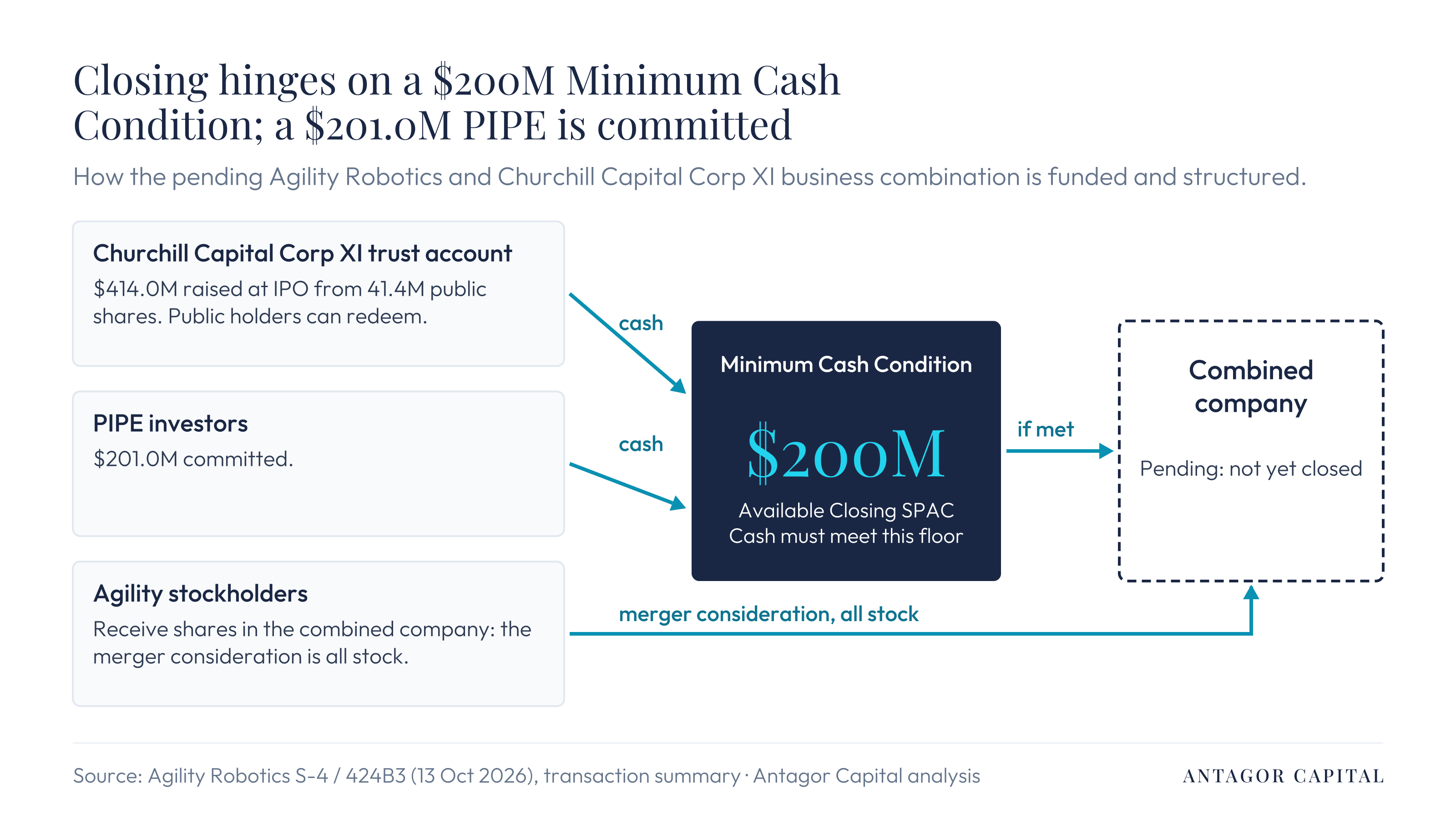
- The transaction is pending. A $2.5 billion all-stock merger, $201.0 million of committed private investment (PIPE) and a $200 million Minimum Cash Condition frame the vote.
What is on the table?
CCXI, a special purpose acquisition company (SPAC), agreed on 24 June 2026 to combine with Agility.
- Consideration: $2.5 billion, paid entirely in shares of the combined company. That is a deal term, not a trading valuation.
- PIPE: $201,025,000 (20,102,500 shares at $10.00), committed by investors.
- Trust account: $414 million placed in trust at the IPO (41.4 million public shares), $420.9 million on 30 June 2026.
- Floor: the deal closes only if at least $200 million of cash is available at closing (the Minimum Cash Condition).
- Vote: an extraordinary general meeting on Monday 2 November 2026 at 9:00 a.m. ET, by live webcast.
Company materials describe about $620 million of gross proceeds if no one redeems. Our check (trust plus the $201.0 million PIPE gives roughly $615 million to $622 million) lands in the same place, before about $46.1 million of estimated transaction expenses.
What has Agility actually sold so far?
Not much, yet. Net sales were $310,301 in 2024 and $1,781,967 in 2025. In the first half of 2026 they were $174,000, against $625,000 a year earlier.
Two details matter. First, $1.13 million of the 2025 figure came from related parties, described as "sales of Digit robots to one investor": 63.5% of net sales (our arithmetic: $1,131,860 divided by $1,781,967). Second, gross margin was negative: 2025 cost of goods sold was $4.47 million against $1.78 million of sales. The filing calls this "an early stage of commercialization", with Digit focused "primarily on repetitive material handling workflows such as moving bins and totes".
What is the $300 million order, exactly?
The filing describes $300 million of multi-year Digit 5 orders "as of May 2026":
- One customer, which "has committed to deploy $300 million of Digit 5 over a multi-year period".
- 1,000 robots on a three-year robots-as-a-service (RaaS) contract: a recurring fee instead of a purchase.
- Warrants issued to the purchaser that vest proportionately as robots are deployed. Vested customer warrants reduce net sales; $9,640 was recognised in 2025.
- Contingent on contractual milestones, features and specifications. The filing warns such orders "may not convert to revenue on the anticipated timeline". Digit 5 was unveiled on 15 September 2026, with early access expected in the first half of 2027.
The filing does not name the purchaser or state a price per robot, and we do not guess either. One arithmetic cross-check, computed by Antagor Capital: $8,500 a month for 36 months across 1,000 robots is $306 million, close to $300 million. That is an inference, not a disclosed term.
How big is the loss, and how much of it is cash?
FY2025 loss from operations was $140.2 million and net loss $138.1 million, up from $70.6 million in 2024. Operating cash use was $99.8 million.
H1 2026 looks far worse on paper: a $362.7 million operating loss and a $361.9 million net loss. But operating cash use was $86.2 million. The gap is mostly non-cash: about $252.5 million of incremental stock-based compensation, including about $121.4 million in selling, general and administrative (SG&A) and $130.8 million in research and development (R&D), which sum to $252.2 million; the filing's liquidity section states the total as about $252.5 million, and we use that figure. The increase is tied to the increased valuation of previously liability-classified awards.
Read the headline loss and the cash burn separately. The first reflects an accounting charge that rose with the valuation. The second is what the company has to fund.
How much cash was left, and what did the auditor say?
Agility held $103.0 million of cash on 31 December 2025 and $14.7 million on 30 June 2026, plus $7.1 million of restricted cash. It has raised about $400.8 million of gross preferred equity and carries a $675.0 million accumulated deficit.
Management concluded there is substantial doubt about Agility's ability to continue as a going concern, "without consideration of the proposed business combination". Grant Thornton LLP's report, dated 13 July 2026, includes an explanatory paragraph to the same effect. The stated basis: existing cash "will not be sufficient" to fund operations for at least one year. That is the context for the $200 million floor, and the deal's cash depends on how many CCXI public shareholders redeem, which no one will know until after the vote.
Is $8,500 a month a real price?
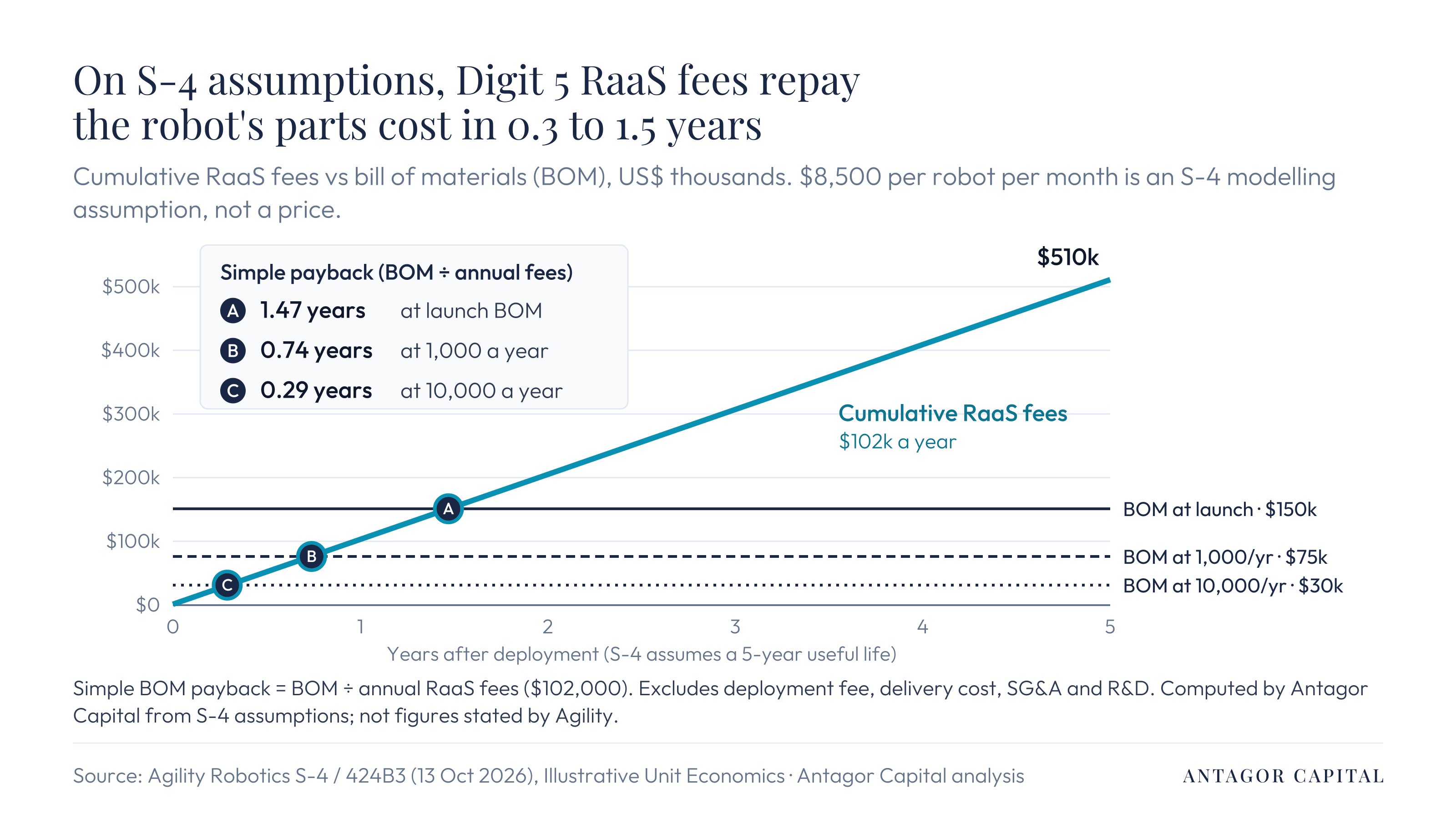
It is the number everyone will quote, so be precise. The S-4's "Unaudited Prospective Unit Economics Information" states a recurring monthly fee of $8,500 that includes software and maintenance, and adds that "the actual terms of the definitive long-term contracts and commercial arrangements with our customers are subject to negotiation". It is a modelling assumption, not a price list and not a contracted rate.
The robot bill of materials (BOM) is the other key input: about $150,000 at commercial launch, with targets of about $75,000 at 1,000 robots a year and about $30,000 at 10,000. The model also assumes a five-year life, about $15,000 a year of delivery cost and about $15,000 of one-time deployment cost. For scale, the 6 October 2026 investor presentation shows a current Digit v4 BOM of about $125,000, a different basis from the $150,000 Digit 5 launch figure.
From those assumptions we computed a simple payback. Annual RaaS fees are $102,000 ($8,500 times 12), and payback is BOM divided by annual fees. Five-year product margin excludes SG&A and R&D. These are our calculations, not figures Agility states, because the S-4 shows its results table as an image. The launch payback matches the roughly 1.5 years in the company's deck.
| Scale point | BOM | Simple BOM payback | Five-year product margin |
|---|---|---|---|
| Commercial launch | $150,000 | 1.47 years | 55% |
| 1,000 robots a year | $75,000 | 0.74 years | 69% |
| 10,000 robots a year | $30,000 | 0.29 years | 78% |
Computed by Antagor Capital from S-4 assumptions. The lesson is about leverage, not price: under this model, nearly the whole story is the BOM falling from $150,000 toward $30,000. That is a manufacturing-scale assumption on a product that reaches early access in the first half of 2027.
The same habit applies to AI-enabled services: a target margin is an assumption until audited results exist, as our AI rollup playbook on services margins argues for services businesses.
The deck also frames the customer's side: a lifetime RaaS cost near $500,000 against about $400,000 for ownership, a 1.1-year customer payback and a 2.0x return, based on a $30.50 hourly fully burdened labour rate across two 10-hour shifts a day. That is company marketing material built on assumptions. It works only if a robot runs two shifts at human-equivalent throughput, which is different from "customers have saved this much".
Who is using Digit today?
According to the filing, Digit v4 was deployed or committed for deployment across nine customer facilities, with more than 65,000 hours of operation as of May 2026. Named customers include Schaeffler, GXO, Toyota Motor Manufacturing Canada and Mercado Libre. Schaeffler reached roughly 98% accuracy over about 25,000 totes, and GXO passed 100,000 totes in November 2025.
Those are real hours on real tasks. But the filing also says a significant portion of revenue is concentrated with a limited number of customers, and the 65,000 hours describe Digit v4, not the Digit 5 robot behind the $300 million order.
How does the vote work, and what do redemptions change?
The filing warns that CCXI public shareholders "may receive only $10.24 per share" (based on trust amounts at 14 September 2026). We cite it only as the redemption mechanism. It is not a signal about where the combined company's shares might trade, and the procedure itself is set out in the proxy statement.
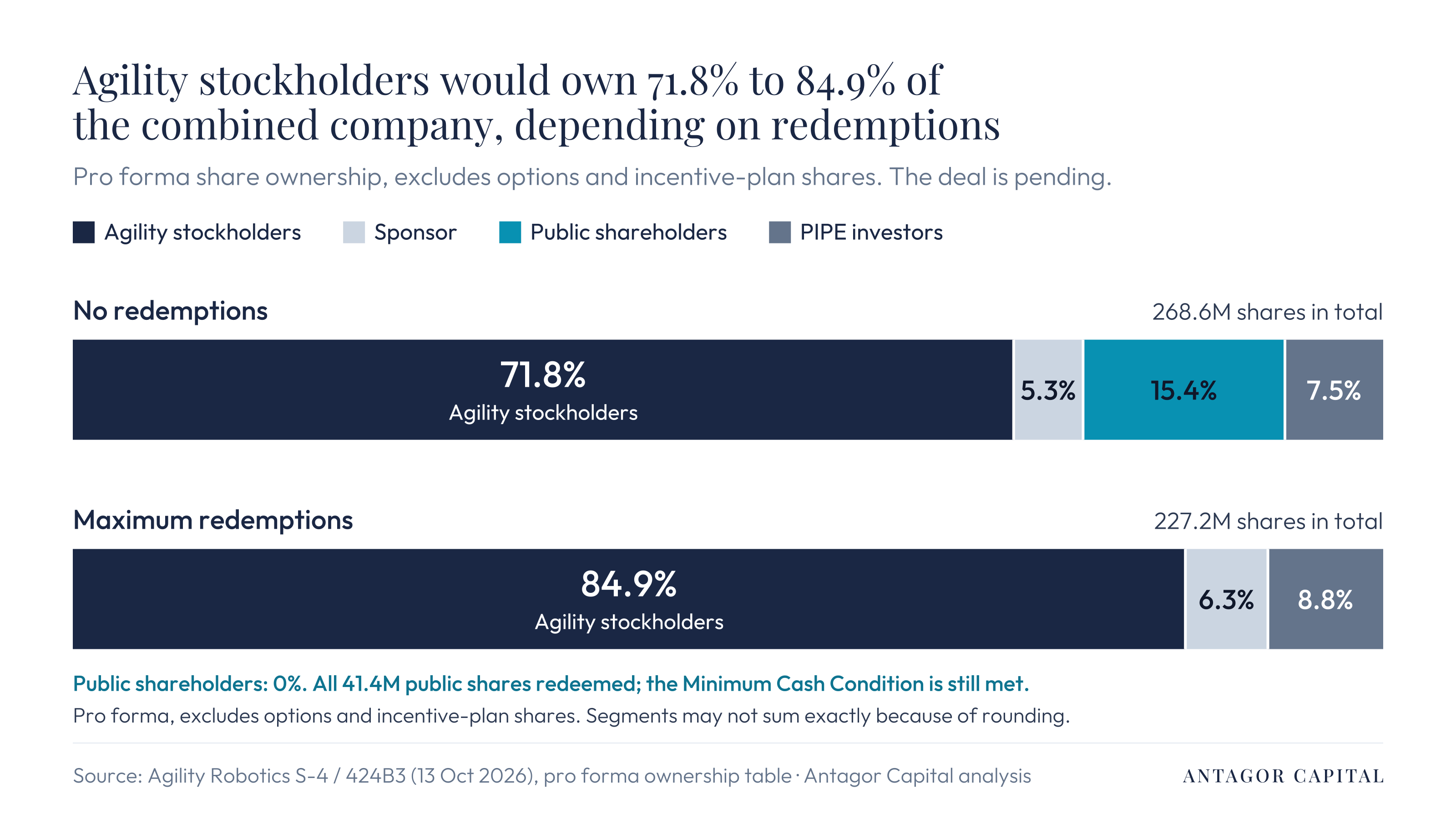
The ownership table shows how much redemptions change who holds what. Pro forma figures exclude options and incentive-plan shares.
| Holder | No redemptions | Maximum redemptions |
|---|---|---|
| Agility stockholders | 71.8% | 84.9% |
| Sponsor (Churchill Sponsor XI LLC) | 5.3% | 6.3% |
| CCXI public shareholders | 15.4% | 0.0% |
| PIPE investors | 7.5% | 8.8% |
| Total shares | 268,591,296 | 227,191,296 |
The maximum case assumes all 41.4 million public shares are redeemed and the Minimum Cash Condition is still met. The S-4 discloses that the sponsor acquired its founder shares for approximately $0.003 per share. Both columns are scenarios in a filing, not forecasts. For the outcome, look to the closing Form 8-K (Items 2.01 and 3.01).
What does this mean for operators and investors?
Antagor Capital's view. This is our reading of the filing. It is not a view on the security, the vote or any redemption decision.
First, separate three layers: what has been sold ($1.78 million), what has been ordered ($300 million, one customer, contingent) and what has been assumed ($8,500 a month, a $30,000 BOM). The S-4 is disciplined about the labels. Readers and headlines are the ones who blur them.
Second, the unit economics are a manufacturing-scale story. At the stated launch BOM, the model pays back in about 1.5 years; at the stated scale targets, in months. The distance between those cases is the thing to watch, not the monthly fee.
Third, for operators weighing a pilot: read a vendor's economics as a stack of assumptions and ask which one fails first. Utilisation and the vendor's ability to keep deploying and supporting robots look like the binding inputs here, and the going-concern language puts the second one in plain sight.
What are the open questions?
- Who the $300 million purchaser is, and whether it has any relationship to Agility. We make no link to any investor or to the 2025 related-party sales.
- The warrant terms, beyond "vest proportionately as robots are deployed".
- The contracted price per robot. The $306 million cross-check is an inference.
- The redemption outcome and cash at closing, unknown until after 2 November.
If the transaction closes or terminates, this article will be re-checked against the post-vote Form 8-K and updated.
Related reading: What is an AI rollup? and the AI rollup playbook on services margins.
FAQ
How much does a humanoid robot cost to build and to rent?
Agility's S-4 assumes a Digit 5 bill of materials of about $150,000 at commercial launch, falling to about $75,000 at 1,000 robots a year and about $30,000 at 10,000. It models a rental (RaaS) fee of $8,500 a month. That fee is an assumption, and actual contract terms are "subject to negotiation".
What were Agility Robotics' revenue and net loss for 2025?
Net sales of $1,781,967 and a net loss of about $138.1 million, per the S-4. Operating cash use was $99.8 million, and $1.13 million of sales came from related parties. Gross margin was negative.
Is the $300 million order revenue?
No. It is a multi-year order from one customer for 1,000 robots on a three-year RaaS contract, contingent on milestones and features. The filing says such figures are "not a measure of current period revenue".
Does Agility Robotics have a going-concern warning?
Yes. Management concluded there is substantial doubt, without considering the proposed business combination, and the auditor's report includes an explanatory paragraph. Cash was $14.7 million on 30 June 2026.
When is the vote, and how does the merger work?
CCXI shareholders meet on 2 November 2026 at 9:00 a.m. ET. The $2.5 billion all-stock merger, backed by a $201.0 million PIPE and about $414 million of trust cash, closes only if $200 million of cash is available. It is pending as of 28 October 2026; the company's deck plans a Nasdaq listing as AGLT.
Sources
- SEC (Churchill Capital Corp XI) — Final proxy statement/prospectus, Form 424B3 (October 2026). https://www.sec.gov/Archives/edgar/data/2074973/000121390026109058/ea0297114-07.htm
- SEC (Churchill Capital Corp XI) — Registration statement amendment, Form S-4/A (September 2026). https://www.sec.gov/Archives/edgar/data/2074973/000121390026105334/ea0297114-05.htm
- SEC (Agility Robotics via Churchill Capital Corp XI) — Investor presentation, Form 8-K Exhibit 99.1 (October 2026). https://www.sec.gov/Archives/edgar/data/2074973/000121390026107259/ea030784201ex99-1.htm
- SEC EDGAR — Churchill Capital Corp XI filing list, Notice of Effectiveness (October 2026). https://www.sec.gov/cgi-bin/browse-edgar?action=getcompany&CIK=0002074973&type=&dateb=&owner=include&count=60
- Agility Robotics — Newsroom (October 2026). https://www.agilityrobotics.com/news
This article is for information only and does not constitute investment, legal or tax advice or an offer to buy or sell any security. Antagor Capital is a brand of TALTX Inc. Views are the authors' own as of the publication date.