
On 29 September 2026, a company that calls itself an AI holding company closed a roughly $6.3 billion all-cash take-private of American Express Global Business Travel. The buyer, Long Lake, is backed by General Catalyst, Alpha Wave, Elad Gil, D1 and Thrive. The target is a people business with a 20% adjusted EBITDA margin.
It is the biggest bet on the AI-enabled services thesis we have seen: buy businesses that run on people, rebuild the work with software you write yourself, and keep the margin. This playbook shows where those margin points come from, which are evidenced and which are still a spreadsheet, and what has to be true before a services firm deserves a software valuation. In short, the plan is to take a typical services firm from about 10% to about 20% EBITDA margin: automate delivery hours, consolidate the back office and reprice the work, then pay for engineers, compute and staff retention.
Key takeaways
- The target is a doubling, not a transformation. General Catalyst says it looks to at least double the EBITDA margin of the services companies it acquires. From a typical starting point of about 10–11% (the average managed IT services provider earned 11.1% adjusted EBITDA in Q4 2024), that means roughly 20%.
- No AI-native rollup has published a post-acquisition margin. Thrive Holdings, Shield, Titan and Long Lake disclose capital raised, deal counts and task-level productivity claims, but not EBITDA margins, as of October 2026.
- The evidenced gains are at task level. OpenAI and Thrive report that a tax agent cut preparation time by about a third across 7,000 returns; Shield says it halved median resolution time on several ticket types. Turning hours saved into margin is a separate, harder step.
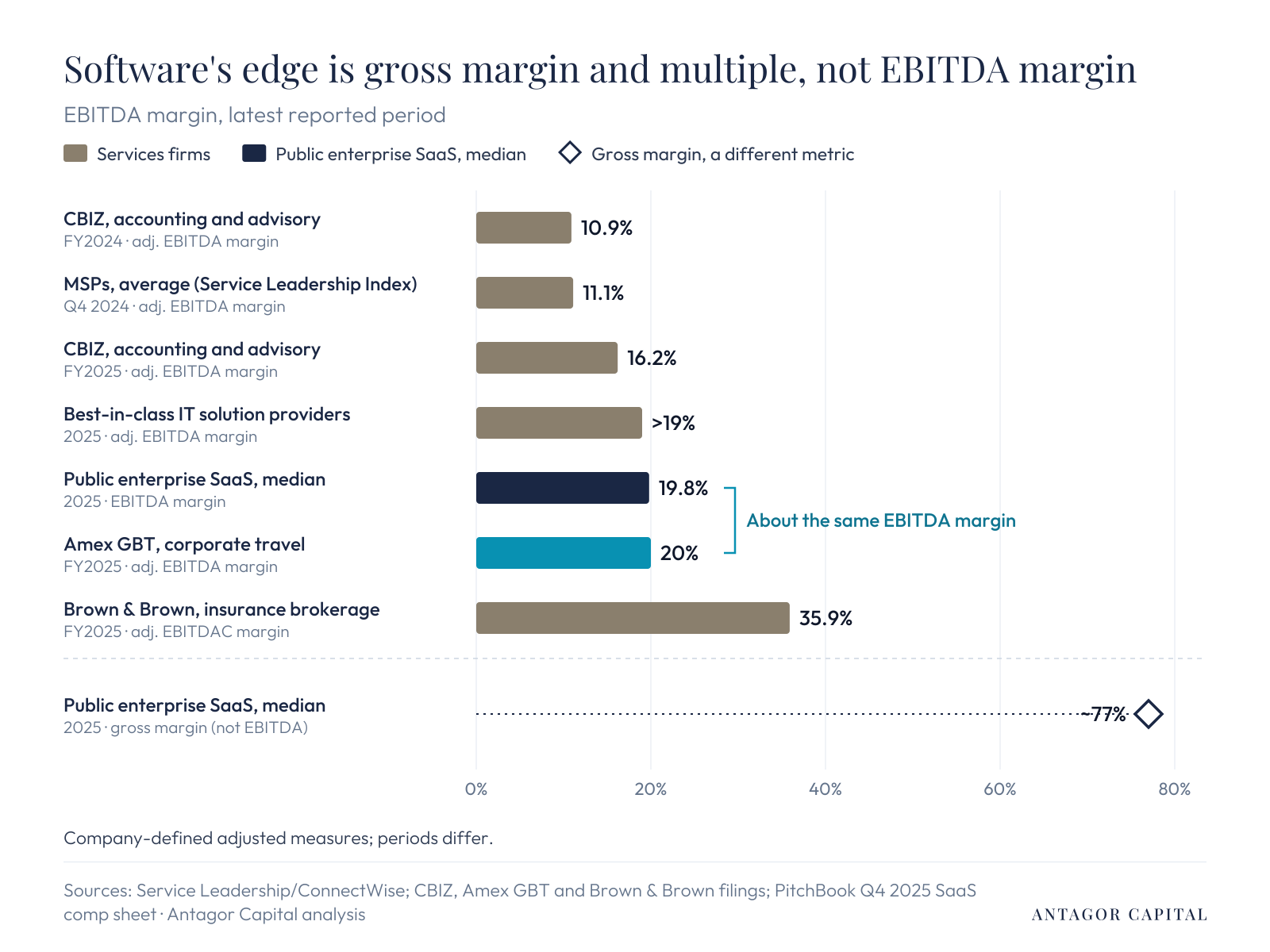
- "Software-like" is mostly about the multiple. The median public enterprise SaaS company earned a 19.8% EBITDA margin in 2025, about the same as Amex GBT's 20%. What software has and services don't is a gross margin near 77% and a valuation multiple to match.
- Antagor Capital's view: the bridge from 10% to about 20% is plausible in high-repeatability verticals, but the return case should be underwritten on reported operating margins, not on an exit multiple that assumes the market will re-rate services as software.
What is an AI-native rollup, and how is it different from buy-and-build?
An AI-native rollup buys several companies in one fragmented services vertical, such as accounting, managed IT services or customer support, and puts its own engineers inside them to automate the delivery work with AI. (For the full definition, examples and FAQ, see what an AI rollup is.)
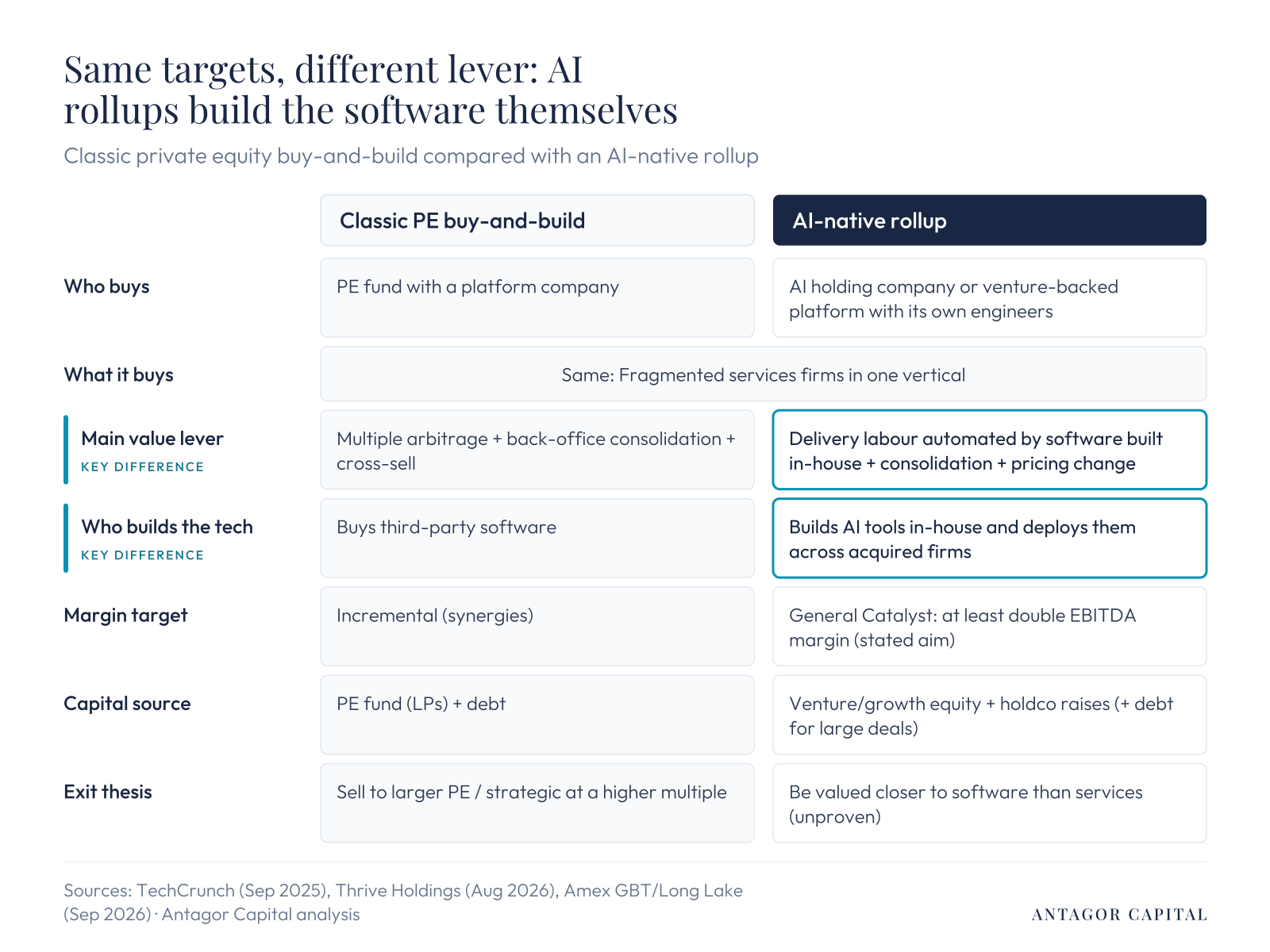
On paper it looks like the private equity buy-and-build long used in dental practices, veterinary clinics and insurance agencies. The targets are the same: owner-run firms, recurring client relationships, too small to invest in technology on their own. The difference is the lever. A classic buy-and-build earns its return from buying small firms at low multiples, consolidating the back office and selling the bigger platform at a higher multiple. An AI-native rollup claims a second engine: software it builds in-house that changes how many hours each unit of work takes.
That changes who the buyer is. Thrive Holdings says it owns and operates more than 70 businesses; Titan, an IT services platform, is backed by General Catalyst. These are venture-style balance sheets with engineering teams, not PE funds with an operating-partner bench.
Who is doing AI rollups, and with how much capital?
The money is real, and concentrated in a handful of vehicles.
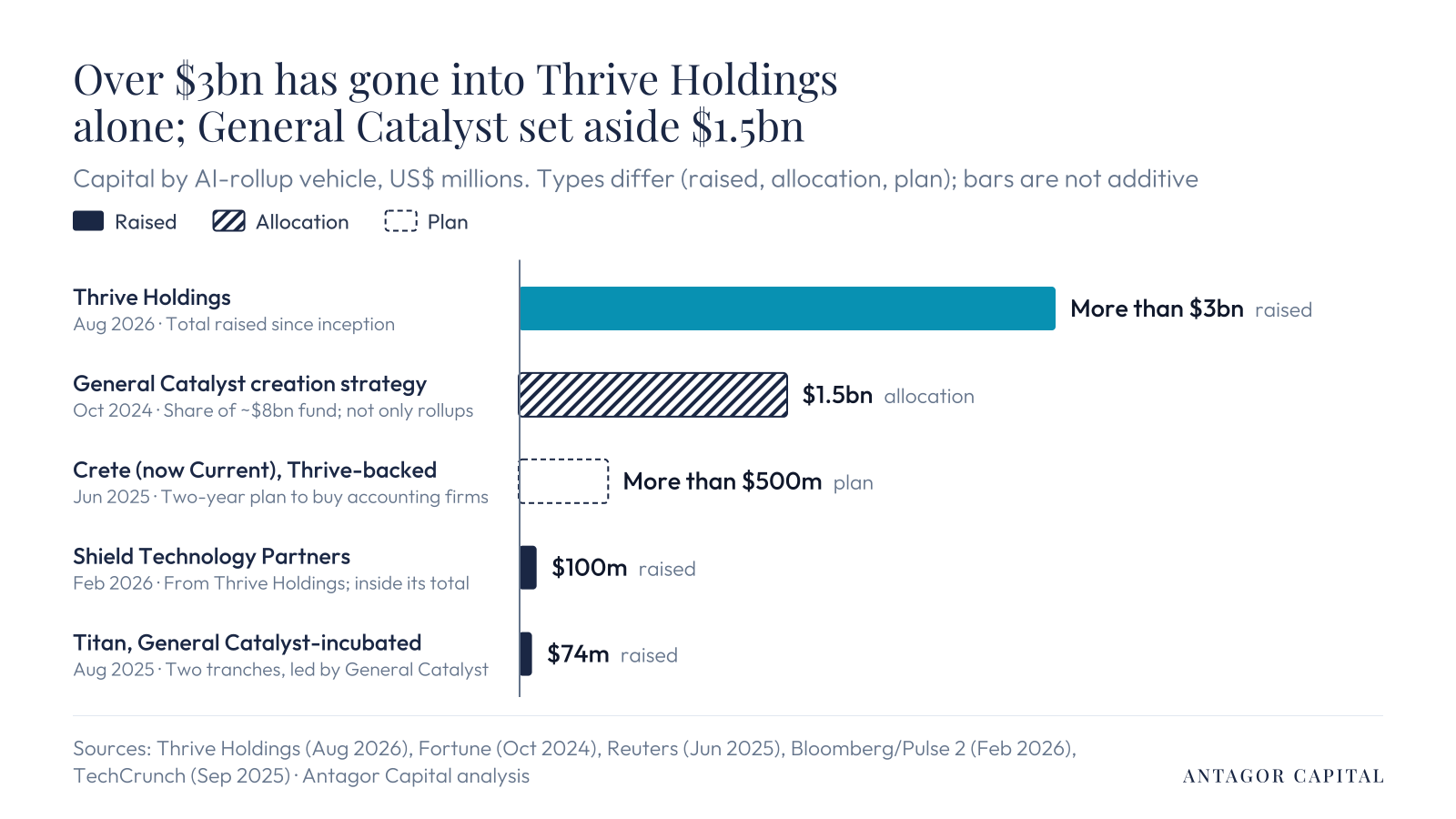
- Thrive Holdings raised more than $2 billion at a $12 billion valuation in August 2026, with new outside investors including D1 Capital Partners, Altimeter and SoftBank. It says it has raised more than $3 billion since inception. Its platforms are in accounting (Crete Professionals Alliance, now operating as Current) and IT services (Shield Technology Partners), and it plans a third for infrastructure approval work.
- Crete told Reuters in June 2025 that it planned to spend more than $500 million acquiring US accounting firms over two years. At the time it had more than 20 firms, 900 employees and over $300 million in annual revenue.
- Shield took $100 million from Thrive Holdings in February 2026. It said it partnered with nine IT services companies serving more than 1,500 customers and passed $100 million in revenue in 2025.
- General Catalyst raised about $8 billion in October 2024 and set aside $1.5 billion for its AI-focused "creation" strategy, which incubates companies such as Titan. TechCrunch reported that the strategy spans seven industries, with plans for up to 20.
- Titan raised $74 million in two tranches, led by General Catalyst, and in August 2025 announced the acquisition of RFA, a New York IT services firm with about 250 employees.
- Long Lake completed the roughly $6.3 billion Amex GBT acquisition in September 2026, at $9.50 a share. The release says Long Lake has acquired and partnered with "dozens" of services businesses.
The pitch behind the capital is a size gap. General Catalyst's Marc Bhargava put global services revenue at about $16 trillion a year, against roughly $1 trillion for software.
Which services verticals are AI rollups targeting?
Accounting and IT services lead, because they combine the conditions the bridge needs. We use five tests, plus a sixth for how much margin is left to win.
| Test | Why it matters | Example evidence |
|---|---|---|
| Labour share of cost | Margin comes from hours. If people aren't most of the cost, there's little to automate | BPOs are people businesses; the Fortune authors put their EBITDA at 10–15% |
| Fragmentation | Many small owners means acquisitions at low prices and room to consolidate | Crete had assembled more than 20 accounting firms by June 2025 |
| Repeatability of work | Agents automate repeated tasks, not one-off judgement | Shield says software and email issues are over 60% of its ticket volume |
| Regulatory moat or barrier | Licensing protects margins after the deal but limits who can own the firm | CPA firms must be majority-owned by licensed CPAs |
| Client stickiness | Recurring clients keep revenue steady while delivery changes | Annual tax work and managed IT contracts recur by design |
| Margin headroom | A high starting margin leaves little to double | Brown & Brown, a scale insurance broker, earned 35.9% adjusted EBITDAC in 2025 |
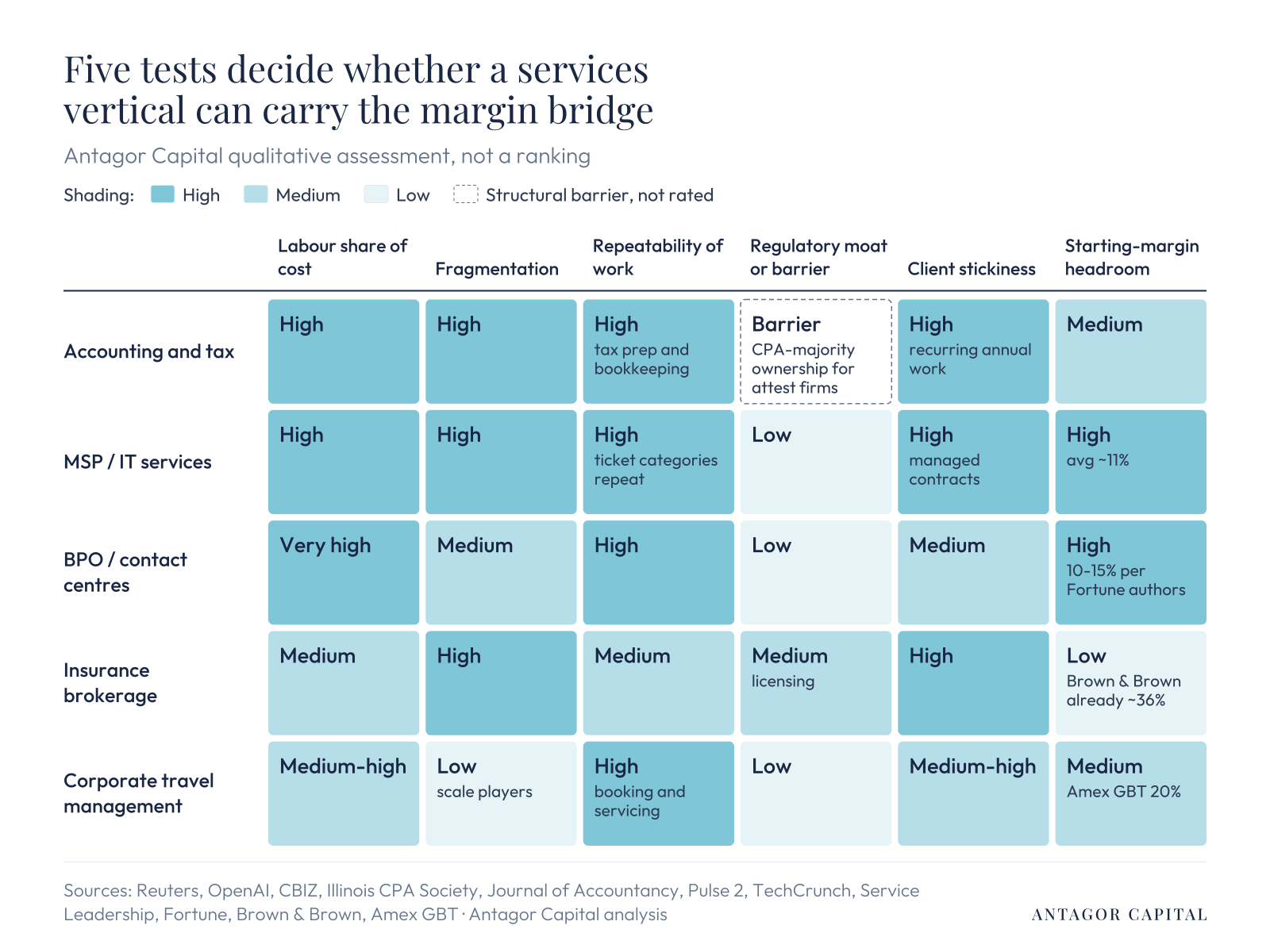
Two results stand out. Accounting scores high on every operational test, but it's the one vertical with an ownership rule built in. Insurance brokerage is fragmented and sticky, but the margin is already high at scale, so the doubling story doesn't apply. "Services firm" isn't one margin profile.
Where do the margin gains in an AI rollup come from?
This is the core of the playbook. Below is an illustrative margin bridge for a services firm with $100 of revenue and $10 of EBITDA. It is Antagor Capital's model, not any company's numbers. Each assumption is stated so you can replace it with your own. Steps are in dollars per $100 of starting revenue; because pricing lifts revenue to $105, the margin is EBITDA divided by $105.
Starting point: about 10%. The average managed IT services provider earned 11.1% adjusted EBITDA in Q4 2024, according to the Service Leadership Index. CBIZ, a listed accounting and advisory firm, reported 10.9% for 2024. The Fortune op-ed by Nathan Benaich and Nikola Mrkšić puts traditional outsourcers at 10–15%. We assume the $90 cost base splits into $60 of delivery labour, $15 of back office and $15 of other operating costs.
Step 1: automate delivery hours (+$9). Assume AI handles 30% of delivery hours, and half of those freed hours become cost savings. The other half go into growth, quality or simply slack. That's $60 × 30% × 50% = $9. The 30% sits inside the claims on record: OpenAI and Thrive report a tax agent saved practitioners about a third of preparation time; Titan said it could automate 38% of typical MSP tasks; Shield says it halved median resolution time on several ticket types.
Step 2: consolidate the back office (+$3). Shared finance, HR, IT and billing across many acquired firms take 20% out of a $15 back office. This is the classic buy-and-build lever, and it doesn't need AI.
Step 3: change the pricing (+$5). Billing by the hour hands every hour saved back to the client. Fixed-fee or outcome pricing lets the owner keep some of the productivity gain. We assume revenue rises $5 on the same cost base. No rollup discloses this number, so treat it as the softest step.
Step 4: pay for the engineers (−$3). The model depends on engineers embedded in the operating companies; Shield said its new capital would fund product innovation as well as acquisitions. We charge 3% of baseline revenue.
Step 5: pay for models and compute (−$1.5). Agents running on every return or ticket cost money. We assume 1.5% of revenue.
Step 6: pay to keep the people (−$1.5). Partners and senior staff who know the clients need retention packages or equity, and the talent pool is shrinking: US schools awarded 55,152 accounting degrees in 2023–24, down 6.6% on the year before. We assume 1.5%.
Result: about 20%. EBITDA of $21 on revenue of $105 is a 20.0% margin. That is roughly the doubling General Catalyst says it aims for.
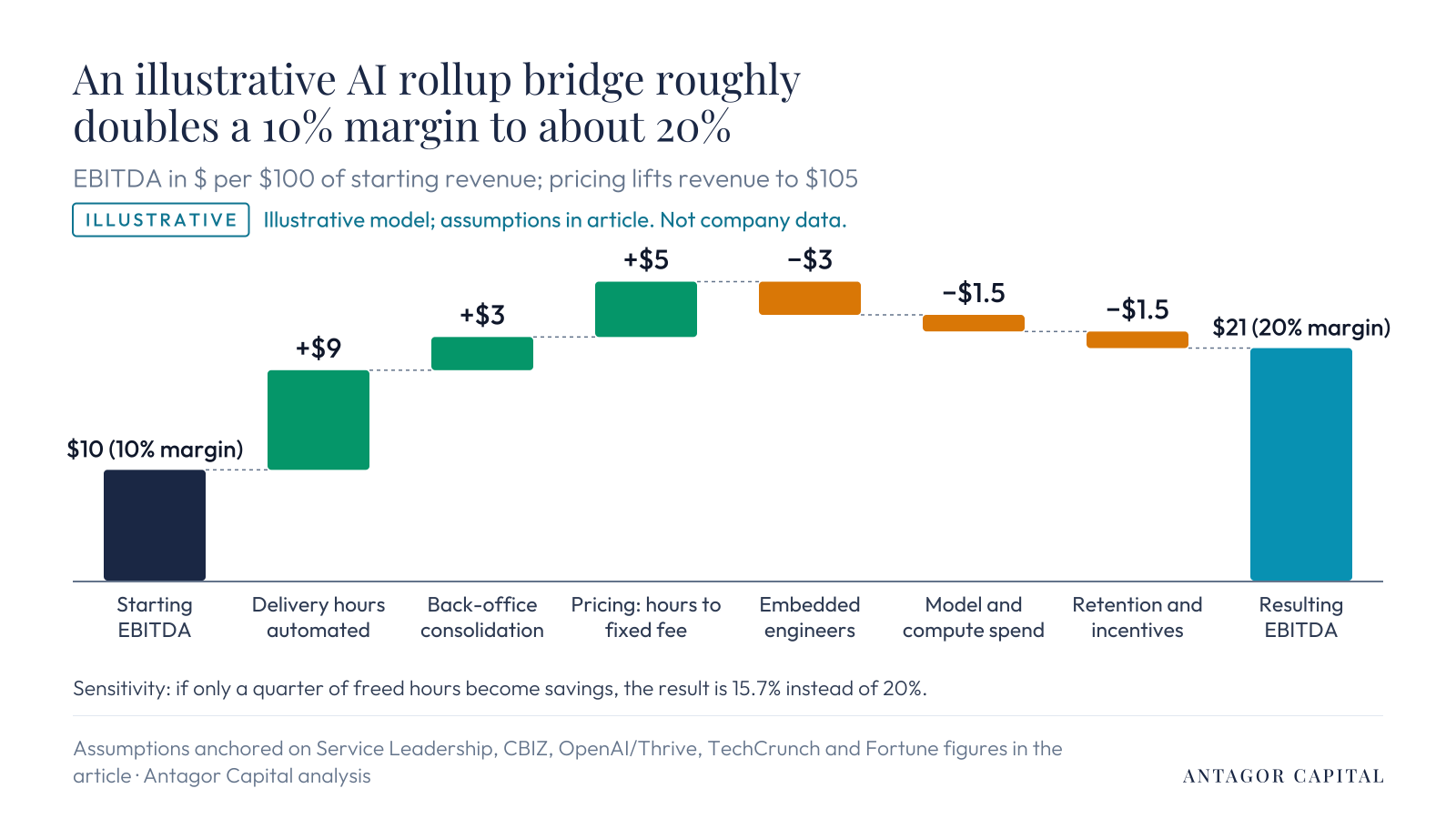
The sensitivity matters more than the base case. If only a quarter of freed hours become savings instead of half, step 1 falls to $4.50 and the result drops to 15.7%. The single most important number in an AI rollup is not the share of work AI can do. It is the share of saved hours that leaves the payroll or turns into new revenue.
Our view: underwrite the realisation rate, not the automation rate. Task-level demos are easy; turning hours into margin is a management problem.
What do public disclosures say about margins after AI?
Very little, and that is the finding.
The AI-native vehicles report inputs, not margins. Thrive Holdings discloses capital raised, the number of businesses and a valuation. OpenAI's case study with Thrive reports 7,000 returns processed, about a third less preparation time, drafts up to 97% accurate and throughput up about 50%. It also notes that, at launch, only a quarter of returns reached 75% correct field completion; six weeks later 86% did. Shield reports faster ticket resolution. None of these vehicles reports EBITDA, and all of the figures above are company-reported and unaudited.
The closest public evidence comes from listed services firms. CBIZ, which acquired Marcum, lifted its adjusted EBITDA margin from 10.9% in 2024 to 16.2% in 2025. Its CEO credited "our combined scale and investments in offshoring, AI, and innovation." That is a real 5.3-point move, but the company doesn't separate AI's share from the Marcum integration and offshoring. Amex GBT, before Long Lake bought it, reported a 20% adjusted EBITDA margin in both 2024 and 2025.
Software is not as far away as the slogan suggests, at EBITDA level. PitchBook puts the 2025 median EBITDA margin of public enterprise SaaS companies at 19.8%. The gap is lower in the P&L: those same companies run a median gross margin of nearly 77%, while Amex GBT's gross profit margin was 57% in 2025. Software scales without adding people. Services, even AI-assisted, mostly don't.
What can break the AI rollup margin bridge?
Multiple arbitrage dressed as operations. Benaich and Mrkšić wrote in Fortune that outsourcers are bought at about 1x revenue and trade near 6x EBITDA, while software commands 20x or more. If an AI rollup buys at services prices and sells at software prices, most of the return can come from the re-rating, not the margin. Their own data cuts against the re-rating: AI-adopting outsourcers such as Concentrix, Genpact and Infosys traded at 5–23x EV/EBITDA in mid-2025, against 22–92x for Salesforce, ServiceNow and Workday. Our rough arithmetic on Long Lake's deal, $6.3 billion headline value over $532 million of 2025 adjusted EBITDA, comes to about 12 times. It is a headline value, not a reconciled EV/EBITDA multiple, but it is a services price, not a software one.
AI output that creates work. A Stanford Social Media Lab and BetterUp study cited by TechCrunch found that 40% of 1,150 full-time employees were taking on extra work because of "workslop", AI output that looks finished but isn't, at a cost of nearly two hours each time. Every review hour comes straight out of step 1 of the bridge. Even General Catalyst's Bhargava told TechCrunch: "it's really hard to transform a company with AI."
Ownership rules. In accounting, CPA firms must be at least majority-owned by licensed CPAs. Outside capital typically comes in through an alternative practice structure: the investor owns a services company that employs the staff, while a legally separate CPA firm keeps control of audit and attest work. That works, but it adds governance, independence rules and a second set of owners to every deal.
People and clients. The partners who hold the client relationships are often the sellers. If they leave after the earn-out, clients can follow, and the accounting talent pipeline is thinning. Owners who sell to an AI-native buyer are also selling to a buyer whose plan, stated openly, is to need fewer hours per client.
Integration debt. A rollup of 70 businesses can mean 70 sets of systems and charts of accounts. Agents need clean, consistent data, so early engineering effort tends to go into plumbing.
What this means for investors, sellers and operators
For PE and growth investors. Ask for the bridge in reported numbers: margin by cohort of acquired firms, before and after the platform's tools went live, with the realisation rate shown separately. Treat task-level productivity claims as product evidence, not financial evidence. Price the deal on what the margin will be at a services multiple. If it only works at a software multiple, it's a bet on the market, not on the operations.
For owners approached by an AI-native buyer. You are being bought for your clients, your people and your process data, and the buyer's model depends on keeping all three while changing how work is done. Understand how earn-outs, retention and pricing changes will land on your team and clients before you sign. In accounting, know which entity you'll own or work for under an alternative practice structure.
For operators inside services firms. You don't need a $3 billion holding company to run steps 1 and 3 of the bridge. Measure hours per unit of work, pick the two or three most repeated tasks, and decide in advance where freed hours go: fewer contractors, more clients per person, or a fixed-fee product.
Antagor Capital's view. The AI rollup is a real operating thesis with a plausible route from about 10% to about 20% EBITDA in repeatable, labour-heavy, fragmented verticals. It is not yet a proven one, and "software-like" is the wrong yardstick: at EBITDA level, a well-run services firm already sits near the software median. The winners will be the platforms that publish margins by cohort and show the realisation rate, not the ones with the biggest raise.
Antagor Capital helps private equity firms and SMEs implement AI automation (our services and use cases). If you're weighing this thesis for a services portfolio, talk to us about AI-enabled value creation in your portfolio.
FAQ
How do AI rollups make money?
AI rollups buy several small services firms in one vertical, then use in-house AI tools to cut the hours each piece of work takes, consolidate back offices and move pricing from hours to fixed fees. In Antagor Capital's illustrative model, those levers, net of engineering, compute and retention costs, take a 10% EBITDA margin to about 20%.
What EBITDA margin do AI rollups target?
General Catalyst, one of the most active backers, has said it aims to at least double the EBITDA margin of the services companies it acquires. Starting from the roughly 10–11% typical of managed IT services providers, that implies about 20%. No AI-native rollup has publicly reported a post-acquisition margin as of October 2026.
Are AI rollups just multiple arbitrage?
They can be. Outsourcers have been bought at about 1x revenue and traded near 6x EBITDA, while software trades at 20x or more. If the return depends on selling at a software multiple, it is arbitrage. If reported margins rise at the operating companies, it is value creation. Investors should ask for cohort-level margins to tell the two apart.
Can private equity or an AI rollup own a CPA firm?
Not as a majority owner of the firm that signs audits. CPA firms must be at least majority-owned by licensed CPAs. Investors usually use an alternative practice structure: they own a services company that employs staff and provides technology and back office, while a separate CPA-owned firm performs and controls audit and attest work.
Sources
- Amex GBT (SEC Form 8-K, Ex. 99.1) — Long Lake completes acquisition of American Express Global Business Travel (September 2026). https://www.sec.gov/Archives/edgar/data/0001820872/000114036126037931/ef20082602_ex99-1.htm
- American Express Global Business Travel — Q4 & FY 2025 Earnings Release (March 2026). https://s201.q4cdn.com/264815268/files/doc_financials/2025/q4/Q4-FY-2025-Earnings-Release-vFinal.pdf
- Thrive Holdings — Thrive Holdings fundraise (August 2026). https://www.thriveholdings.com/thrive-holdings-fundraise
- Reuters via Yahoo Finance — Thrive-backed accounting firm Crete plans to invest over $500 million (June 2025). https://finance.yahoo.com/news/thrive-backed-accounting-firm-crete-130200467.html
- OpenAI — Building self-improving tax agents with Codex (May 2026). https://openai.com/index/building-self-improving-tax-agents-with-codex/
- Bloomberg — Thrive Holdings Makes a $100 Million Bet on AI for IT Help (February 2026). https://www.bloomberg.com/news/articles/2026-02-02/thrive-holdings-makes-a-100-million-bet-on-ai-for-it-help
- Pulse 2 — Shield Lands $100 Million From Thrive Holdings To Scale AI First IT Services Platform (February 2026). https://pulse2.com/shield-technology-partners-100-million-thrive-holdings/amp/
- Fortune — General Catalyst's Hemant Taneja on AI, LPs and raising around $8 billion (October 2024). https://fortune.com/2024/10/25/general-catalysts-hemant-taneja-on-ai-lps-and-raising-around-8-billion/
- TechCrunch — The AI services transformation may be harder than VCs think (September 2025). https://techcrunch.com/2025/09/28/the-ai-services-transformation-may-be-harder-than-vcs-think/
- Gunderson Dettmer — Titan raises $74 million financing led by General Catalyst (August 2025). https://www.gunder.com/print/v2/content/23015/titan-raises-74-million-dollar-financing-led-by-general-catalyst.pdf?lang=en
- Fortune (Nathan Benaich and Nikola Mrkšić) — 'AI roll-up' investors think services firms can trade more like software companies. Here's what they get wrong (June 2025). https://fortune.com/2025/06/27/ai-rollup-investment-strategy
- ConnectWise / Service Leadership — Service Leadership Index Q4 data (February 2025). https://www.connectwise.com/company/press/releases/service-leadership-index-q4-data
- CBIZ, Inc. (SEC Form 8-K, Ex. 99.1) — Fourth quarter and full year 2025 results (February 2026). https://www.sec.gov/Archives/edgar/data/944148/000094414826000035/q42025earningrelease.htm
- Brown & Brown, Inc. (SEC Form 8-K, Ex. 99.1) — Fourth quarter 2025 results (January 2026). https://www.sec.gov/Archives/edgar/data/79282/000119312526022760/bro-ex99_1.htm
- PitchBook — Q4 2025 Enterprise SaaS Public Comp Sheet and Valuation Guide (January 2026). https://pitchbook.brightspotcdn.com/a2/87/6afd77924e28bd3872a62ae43873/q4-2025-enterprise-saas-public-comp-sheet-and-valuation-guide.pdf
- Illinois CPA Society — Alternative Practice Structures: Opportunity and Responsibility (Fall 2025). https://www.icpas.org/information/copy-desk/insight/article/fall-2025/alternative-practice-structures-opportunity-and-responsibility
- Journal of Accountancy — The accounting graduate pipeline: Where do things stand? (October 2025). https://www.journalofaccountancy.com/news/2025/oct/the-accounting-graduate-pipeline-where-do-things-stand/
- Accounting Today — Crete rebrands as Current (June 2026). https://www.accountingtoday.com/news/crete-professionalls-alliance-rebrands-as-current
This article is for information only and does not constitute investment, legal or tax advice or an offer to buy or sell any security. Antagor Capital is a brand of TALTX Inc. Views are the authors' own as of the publication date.