An AI rollup (also written AI roll-up) is an acquisition strategy in which a buyer acquires several established services businesses, such as accounting, IT support or property management firms, and rebuilds how their work is done with AI software and in-house engineers. The aim is higher margins and faster growth than the firms could reach on their own.
The term describes a business model, not the blockchain "rollup" used in crypto. Investors also call it an AI-enabled rollup, an AI-native rollup or an AI holding company.
Key takeaways
- An AI rollup buys services firms for their clients, staff and cash flow, then uses AI software built by its own engineers to change how the work is done.
- Thrive Holdings raised more than $2 billion at a $12 billion valuation in August 2026 and says it owns and operates more than 70 businesses, with platforms in accounting and IT services.
- General Catalyst dedicated $1.5 billion of its latest fund to its "creation" strategy and aims to at least double the EBITDA margin of the companies it acquires, according to TechCrunch.
- Long Lake completed its roughly $6.3 billion take-private of American Express Global Business Travel on 29 September 2026, taking the model from small firms to a public company.
- No AI rollup has published audited margin results; the margin gains are investor targets and company-reported early metrics.
How does an AI rollup work?
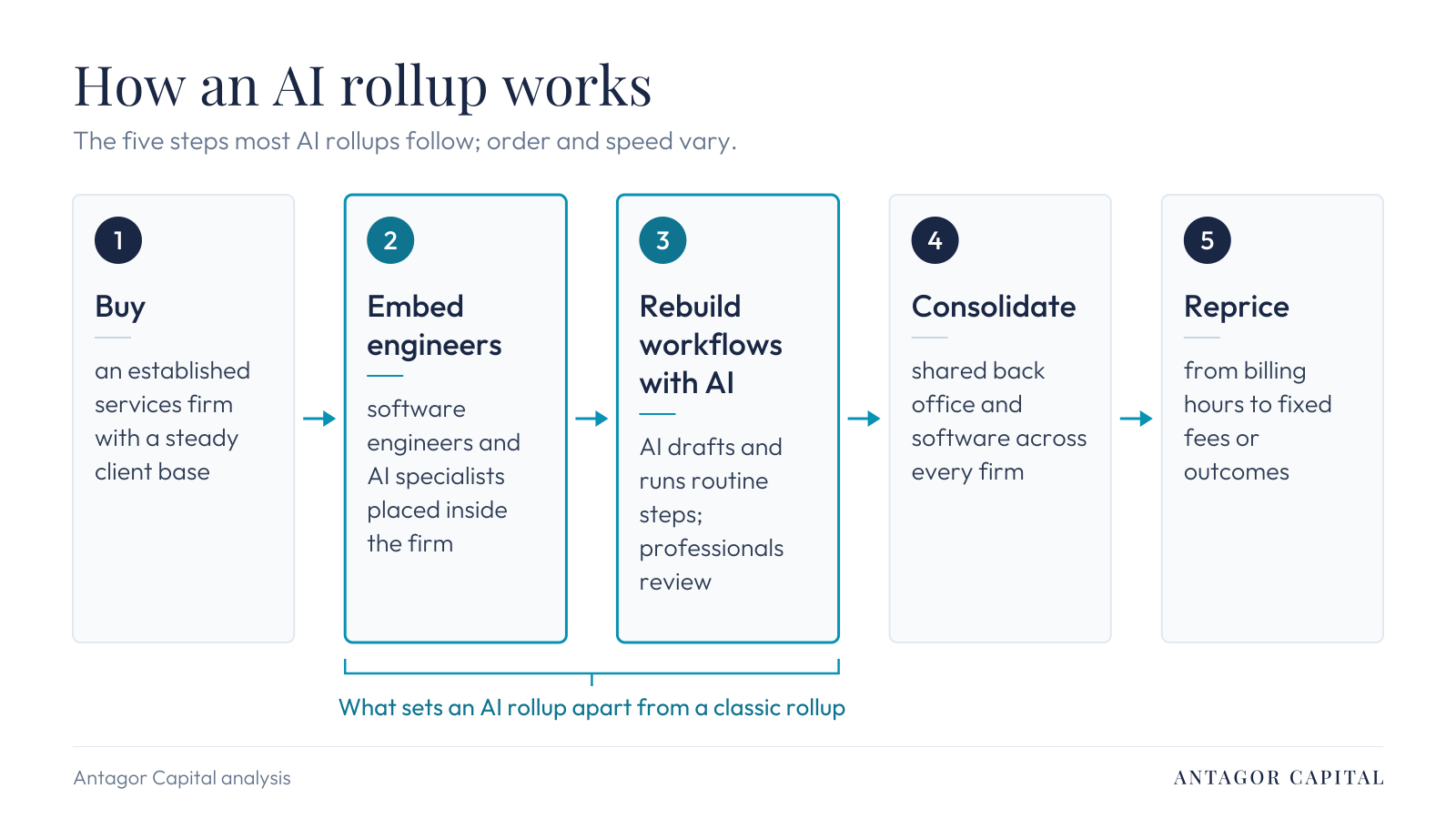
Most AI rollups follow the same five steps, though the order and speed vary.
- Buy. Acquire an established services firm with a steady client base, often owner-led. The buyer pays for clients, contracts and a trained team, not for technology.
- Embed engineers. Place the platform's own software engineers and AI specialists inside the acquired firm. This is the step that separates an AI rollup from a classic rollup.
- Rebuild workflows with AI. Map the repeatable work (tax preparation, IT tickets, document review, scheduling) and rebuild it so AI agents do first drafts and routine steps while professionals review and handle exceptions.
- Consolidate. Move each new firm onto shared software, finance, HR and sales, so every later acquisition plugs into a platform that already exists.
- Reprice. Shift, where clients accept it, from billing hours to fixed fees or outcomes, so the time saved becomes margin rather than lower bills.
The first three steps are what investors mean when they say the integration thesis is software, not scale.
How is an AI rollup different from a private equity rollup or vertical SaaS?
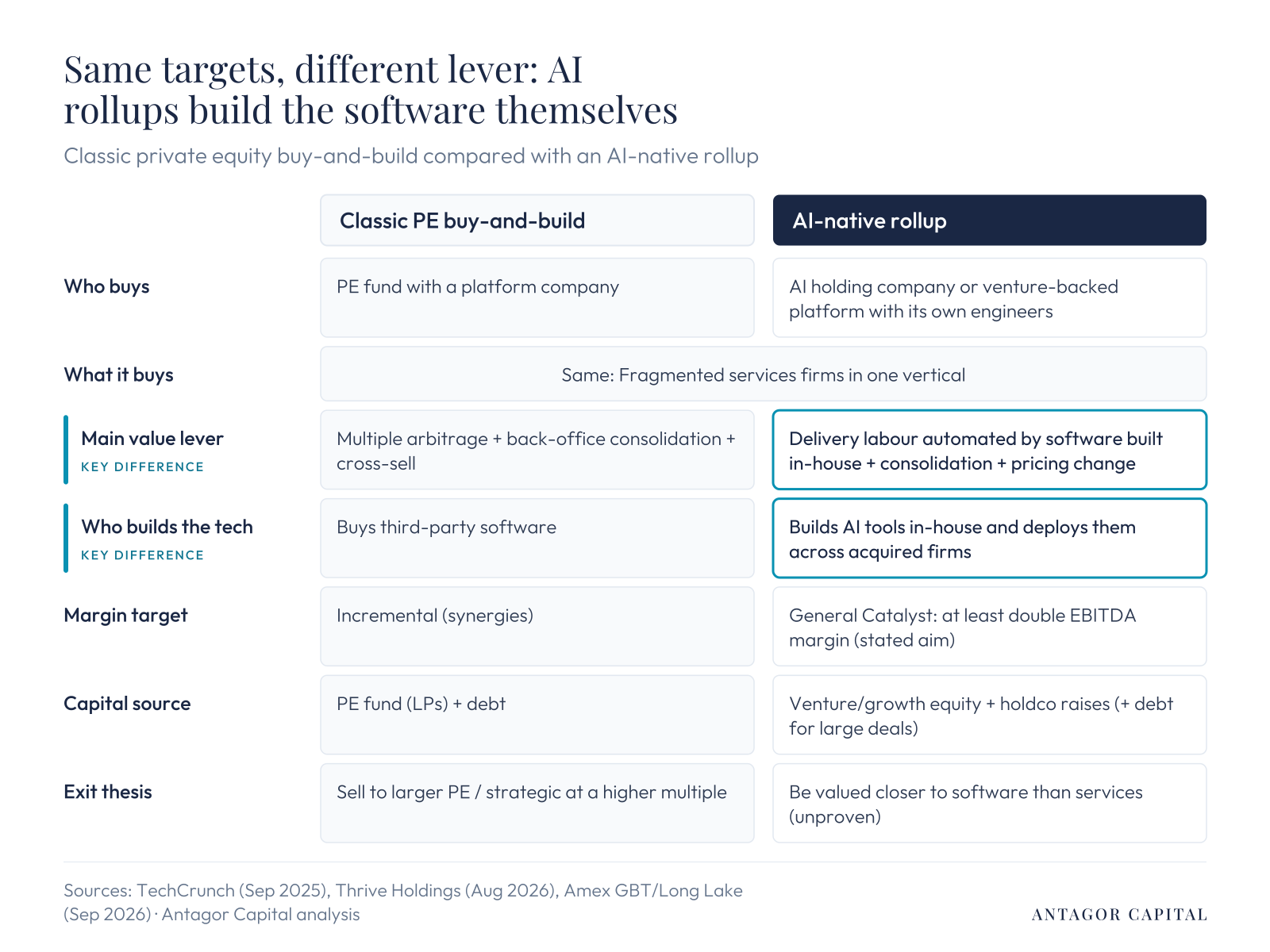
A traditional private equity rollup, or buy-and-build, also buys many small firms in one sector. The difference is where the value is supposed to come from.
| AI rollup | Traditional PE rollup (buy-and-build) | Vertical SaaS | |
|---|---|---|---|
| What is bought or built | Services firms, then rebuilt with in-house AI software | Services or product firms, combined into a larger group | Software, built and sold to firms in one industry |
| What the customer pays for | The finished work (a tax return, a resolved IT ticket) | The finished work, usually billed by the hour or by contract | A software licence or subscription; the customer still does the work |
| Main source of margin | Fewer labour hours per unit of work, plus shared back office and pricing | Purchasing power, shared overhead, cross-selling | High gross margin on software that is cheap to copy |
| Capital needs | Acquisition capital plus an engineering team | Acquisition capital, often with debt | Venture capital for product and sales |
| Exit logic | Sell or list as a tech-enabled company valued above services multiples | Sell a larger platform at a higher multiple than the add-ons cost | Sell or list on recurring revenue multiples |
| Typical backers | Venture firms and new AI holding companies | Private equity firms | Venture capital |
In short, a buy-and-build adds firms to get bigger. An AI rollup adds firms to a software platform that is meant to change the cost of each unit of work. Vertical SaaS sells that software to firms instead of owning them.
Which companies are doing AI rollups?
Several venture-backed vehicles have announced AI rollups. The figures below are what each company or tier-1 reporting has published; none are audited operating results.
| Vehicle | Sector focus | What has been announced | Date |
|---|---|---|---|
| Thrive Holdings | Accounting, IT services; infrastructure planned | More than $2 billion raised at a $12 billion valuation from D1 Capital Partners, Altimeter Capital and SoftBank Group; more than $3 billion raised since inception; 70+ businesses owned and operated | 12 Aug 2026 |
| Crete Professionals Alliance (Thrive-backed) | Accounting | Planned to invest over $500 million to buy US accounting firms over two years; had 20+ firms, 900 employees and over $300 million in annual revenue (Reuters) | 4 Jun 2025 |
| Shield Technology Partners (Thrive Holdings platform) | IT services | $100 million from Thrive Holdings; nine partner IT firms, 1,500+ customers, over $100 million revenue in 2025; reports median ticket resolution time cut by more than 50% in certain use cases | 2 Feb 2026 |
| Titan (General Catalyst) | IT managed services | $74 million led by General Catalyst and the acquisition of RFA, an MSP serving financial services; General Catalyst's Marc Bhargava told TechCrunch (Sep 2025) that Titan's pilots showed 38% of typical MSP tasks could be automated | 12 Aug 2025 |
| Long Lake | Corporate travel and other services | Founded in 2023; agreed to acquire Amex GBT for $9.50 per share in cash (about $6.3 billion) and completed the deal on 29 Sep 2026 | 4 May 2026 / 29 Sep 2026 |
General Catalyst is the most cited venture investor in the space. TechCrunch reported in September 2025 that it had dedicated $1.5 billion of its latest fundraise to its "creation" strategy, which incubates AI-native software companies that then buy services firms. It had placed bets across seven industries and planned up to 20.
Thrive Holdings announced in December 2025 that OpenAI would become an owner in the company and that OpenAI teams would work with its engineers and operators.
Long Lake shows the model moving beyond small firms. Its acquisition of Amex GBT was a public-company take-private, not a rollup of small practices, and the completion release calls Long Lake "the World's First AI Holding Company", which is the company's own description.
How do AI rollups make money?
The model makes money in two ways: by doing the same work with fewer labour hours, and, its critics say, by buying at services prices and selling at technology prices.
On operations, the margin comes from automating routine tasks, freeing professional capacity to serve more clients, sharing one back office across many firms, and pricing by outcome rather than by hour. General Catalyst's stated goal is to at least double the EBITDA margin of the firms it buys. That is a target, not a reported result.
On valuation, Nathan Benaich and Nikola Mrkšić wrote in a 2025 Fortune op-ed that traditional business process outsourcing firms trade at about 6x EBITDA while software companies command 20x or more. That gap is the multiple arbitrage that sceptics say may drive returns more than the operations do.
We break down the margin step by step, with what is disclosed and what is modelled, in the AI rollup playbook: how AI-native buyers plan to double a 10% services margin.
What are the risks of an AI rollup?
- Ownership rules. In regulated professions the buyer may not be allowed to own the firm outright. US CPA firms, for example, must be at least majority owned by licensed CPAs, so private equity usually invests through an alternative practice structure, in which the CPA firm and a non-attest company are legally separate entities.
- People and clients. The value bought is mostly partners, staff and client relationships. If key people leave after the sale, or clients move when the founder exits, the platform has less to automate.
- Unproven margins. Public disclosures so far are company-reported operating metrics, such as resolution times. None of the vehicles above has published audited margin data.
- Multiple arbitrage. If returns depend on selling at software multiples, they depend on buyers agreeing the business is now technology. Benaich and Mrkšić call the thesis "a fundamental category error: confusing operational improvement with business model transformation."
- Execution. Rebuilding workflows inside dozens of acquired firms at once is an integration project, not a software rollout.
Our view: the useful test for any AI rollup is whether its margin gains can be traced to fewer hours per unit of work. Where they can't, the return is a bet on the exit multiple.
FAQ
Is an AI rollup the same as services-as-software?
Not quite. Services-as-software is the broader idea that AI lets a company sell the finished outcome of a service rather than a tool. Foundation Capital set out the idea in a 2024 essay. An AI rollup is one way to pursue it: instead of selling software to services firms, the buyer owns the firms and delivers the outcome itself.
Which industries are AI rollups targeting?
Announced vehicles focus on accounting and tax, IT managed services and corporate travel. The common traits are a large share of revenue spent on labour, repeatable work, many small owner-run firms, and clients who stay for years. Thrive Holdings has also announced a planned platform for infrastructure permitting and compliance work.
How is an AI rollup financed?
So far mostly with equity raised from venture firms and the holding companies' own investors. Thrive Holdings has raised more than $3 billion since inception, with D1 Capital Partners, Altimeter Capital and SoftBank Group joining in 2026. General Catalyst set aside $1.5 billion of a fund. Long Lake paid about $6.3 billion in cash for Amex GBT.
Who started AI rollups?
No single firm can be credited. Long Lake was founded in 2023, Crete's plan to spend over $500 million on accounting firms was reported in June 2025, and General Catalyst's $1.5 billion creation strategy was reported in September 2025. Fortune and TechCrunch both covered the term "AI rollup" in 2025.
Is an AI rollup just multiple arbitrage?
That is the main criticism. Commentators argue the return may come from buying services firms at about 6x EBITDA and selling them as technology at 20x or more. Supporters answer that margins only rise if AI cuts the hours needed per unit of work. Until audited margin data is published, neither side can prove its case.
What does an AI rollup mean for a business owner who is approached?
The buyer usually wants the client base, staff and processes, and plans to change how work is done after the sale. Owners should ask how the buyer measures automation, what happens to staff and pricing, how earn-outs are structured, and whether professional ownership rules allow the deal. This is general information, not advice.
How long does an AI rollup take to show results?
There is no public benchmark yet. The early disclosures are operating metrics reported within months of acquisition, such as Shield's report of median ticket resolution times cut by more than 50% in some use cases. Margin results across a full platform have not been published by any of the vehicles named here.
Where to go next
- The economics in detail: the AI rollup margin bridge
- How Antagor Capital works with PE firms and SMEs on AI automation: services and use cases
- More analysis: Insights
Talk to us about AI-enabled value creation in your portfolio: contact Antagor Capital.
Sources
- Thrive Holdings — Thrive Holdings fundraise announcement (August 2026). https://www.thriveholdings.com/thrive-holdings-fundraise
- Thrive Holdings — Thrive Holdings x OpenAI (December 2025). https://www.thriveholdings.com/thrive-holdings-x-openai
- Reuters via Yahoo Finance — Thrive-backed accounting firm Crete to spend $500 million in AI roll-up (June 2025). https://finance.yahoo.com/news/thrive-backed-accounting-firm-crete-130200467.html
- Channel Insider — Shield Technology Partners Announces $100M Investment (February 2026). https://www.channelinsider.com/channel-business/shield-technology-partners-funding/
- TechCrunch — The AI services transformation may be harder than VCs think (September 2025). https://techcrunch.com/2025/09/28/the-ai-services-transformation-may-be-harder-than-vcs-think/
- VC News Daily — Titan AI venture capital funding (August 2025). https://vcnewsdaily.com/titan-ai/venture-capital-funding/ltrnzxnjgx
- Global Business Travel Group, Inc. (SEC Form 8-K, Exhibit 99.1) — Long Lake agrees to acquire American Express Global Business Travel (May 2026). https://www.sec.gov/Archives/edgar/data/0001820872/000114036126018699/ef20072315_ex99-1.htm
- Global Business Travel Group, Inc. (SEC Form 8-K, Exhibit 99.1) — Long Lake completes acquisition of American Express Global Business Travel (September 2026). https://www.sec.gov/Archives/edgar/data/0001820872/000114036126037931/ef20082602_ex99-1.htm
- Fortune — Nathan Benaich and Nikola Mrkšić, ‘AI roll-up’ investors think services firms can trade more like software companies. Here’s what they get wrong (June 2025). https://fortune.com/2025/06/27/ai-rollup-investment-strategy/
- Illinois CPA Society, Insight Magazine — Alternative Practice Structures: Opportunity and Responsibility (Fall 2025). https://www.icpas.org/information/copy-desk/insight/article/fall-2025/alternative-practice-structures-opportunity-and-responsibility
- Foundation Capital — AI leads a service as software paradigm shift (2024). https://foundationcapital.com/ai-service-as-software/
This article is for information only and does not constitute investment, legal or tax advice or an offer to buy or sell any security. Antagor Capital is a brand of TALTX Inc. Views are the authors' own as of the publication date.